Aero-Lift Aircraft Lift

Hangar Space Solutions
Airplane Storage & Aircraft Storage Solutions
Hangar Storage
Aircraft Lift
Aircraft Hoist

FAQ

Applications
Q.1 I operate a Flight School/FBO/Paint Shop/Maintenance Facility and I would like to use the Aero-Lift in my business. What should I know about the Aero-Lift in these commercial applications?


Dimensions/Weight/Hangar Fit
Q.2 What gross weight can the Aero-Lift support?
Q.3 How much does the Aero-Lift itself weigh?
Q.4 What are the dimensions of the Aero-Lift?
Q.5 Can the Aero-Lift be configured for both tail-dragger and tricycle gear aircraft?
Q.6 Will my plane fit on the Aero-Lift?
Q.7 How much hangar space do I need for an Aero-Lift?
Q.8 How high will the Aero-Lift raise my aircraft?


Assembly/Equipment/Tools/Electrical Service
Q.9 Does the Aero-Lift need to be "attached" to my hangar?
Q.10 What is the Foundation or Floor Mount Option and what is required?
Q.11 How long will it take me to assemble my Aero-Lift?
Q.12 Is special equipment required to receive the Aero-Lift, and particularly, to raise the vertical column?
Q.13 What tools and/or equipment are needed to assemble my Aero-Lift?
Q.14 What options do I have if I don't want to install the Aero-Lift myself?
Q.15 What type of electrical service do I need at my hangar to power the Aero-Lift?
Q.16 Once my Aero-Lift is completely assembled, how difficult is it to adjust its position in my hangar?


Purchasing/Shipping
Q.17 How is the Aero-Lift shipped to my hangar?
Q.18 Where can I purchase my Aero-Lift?


Safety/Insurance/Warranty
Q.19 Was the Aero-Lift designed with earthquake concerns in mind?
Q.20 What safety features are designed into the Aero-Lift?
Q.21 What is the warranty of the Aero-Lift?
Q.22 Will my insurance company have any issues with my aircraft being stored on my Aero-Lift?


A.1

I operate a Flight School/FBO/Paint Shop/Maintenance Facility and I would like to use the Aero-Lift in my business. What should I know about the Aero-Lift in these commercial applications?


In addition to multiple uses for individual plane owners, almost half of the Aero-Lift installed base is in commercial applications. Aero-Lift is designed for the demands of commercial applications with duty cycles that are appropriate for high volume operations. FBOs, Maintenance Facilities and Paint Shops find Aero-Lift indispensable for procedures that require access to the underside of the plane.


Maintenance, Painting, and Detailing:

Painters and detailers have unfettered access to the bottom of the aircraft, and maintenance facilities use the Aero-Lift for safe and easy access to the gear and belly of the aircraft for Annuals. Lift and retract is quick and easy, no messy jack stands and precarious tail weights. And lost time claims due to back injuries will be a thing of the past; the Aero-Lift is a valuable tool in creating a more efficient and safe work environment.


FBOs and Flight Schools:

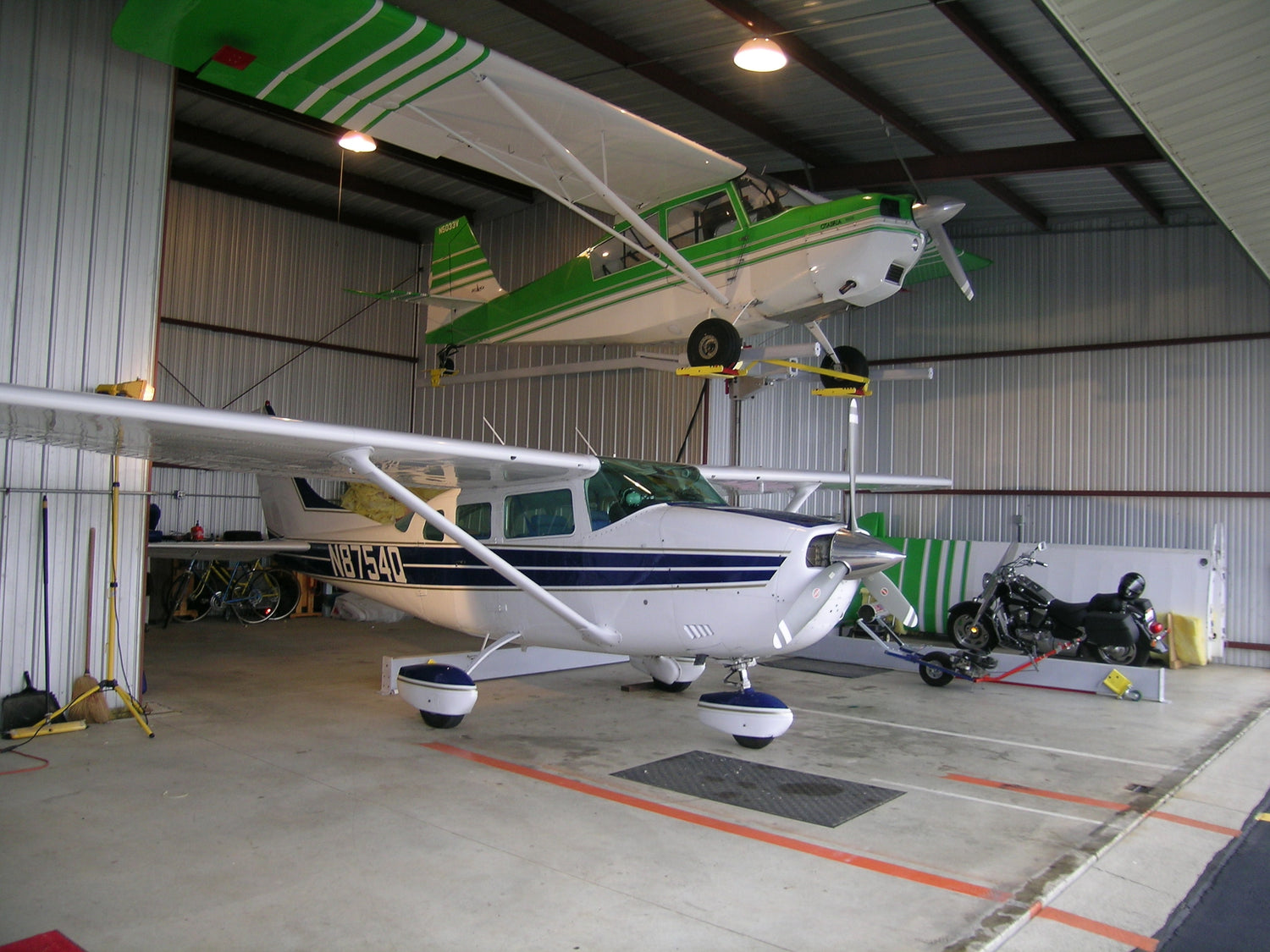
FBOs use Aero-Lift to provide high density airplane hangaring solutions for their customers, essentially doubling their hangar space, freeing up floor space and reducing their fixed costs. Flight Schools use our product to store more training aircraft in their hangars, protecting their fleet from harsh weather and reducing pre-flight time in extreme conditions.


Return to top


A.2

What gross weight can the Aero-Lift support?


Your Aero-Lift was designed to accommodate any aircraft that has a Storage Weight of less than 2,500 lbs and a total gear width of less than 12 feet. With this in mind your Aero-Lift can safely and efficiently lift over 98% of all single engine, piston driven GA aircraft. When considering the capacity of your Aero-Lift please remember to calculate the Storage Weight of your aircraft, which is not the same as the aircraft's Gross Weight. The best way to calculate the Storage Weight of your aircraft is to determine your aircraft's Empty Weight (from your Pilot’s Operating Handbook) then add in the weight of the fuel that you typically store in the aircraft, plus any other items like portable oxygen tanks, charts, chart bags, spare oil, tie-downs, emergency kits, etc. that remain in the aircraft. Remember, the Storage Weight of your aircraft should be less than its maximum certified Gross Weight.


Storage Weight = Empty Weight + (Fuel Gallons x 6) + Other Items

Please refer to the ARM Aerospace web site page entitled Aircraft Specs for a complete listing of GA aircraft with the Empty Weights and Storage Weights.


Return to top


A.3

How much does the Aero-Lift itself weigh?


Your Aero-Lift assembly weighs approximately 2,700 lbs. Of course the Aero-Lift consists of several components that make up this weight. The single heaviest component is the vertical column that weighs approximately 750 lbs.


Return to top


A.4

What are the dimensions of the Aero-Lift?


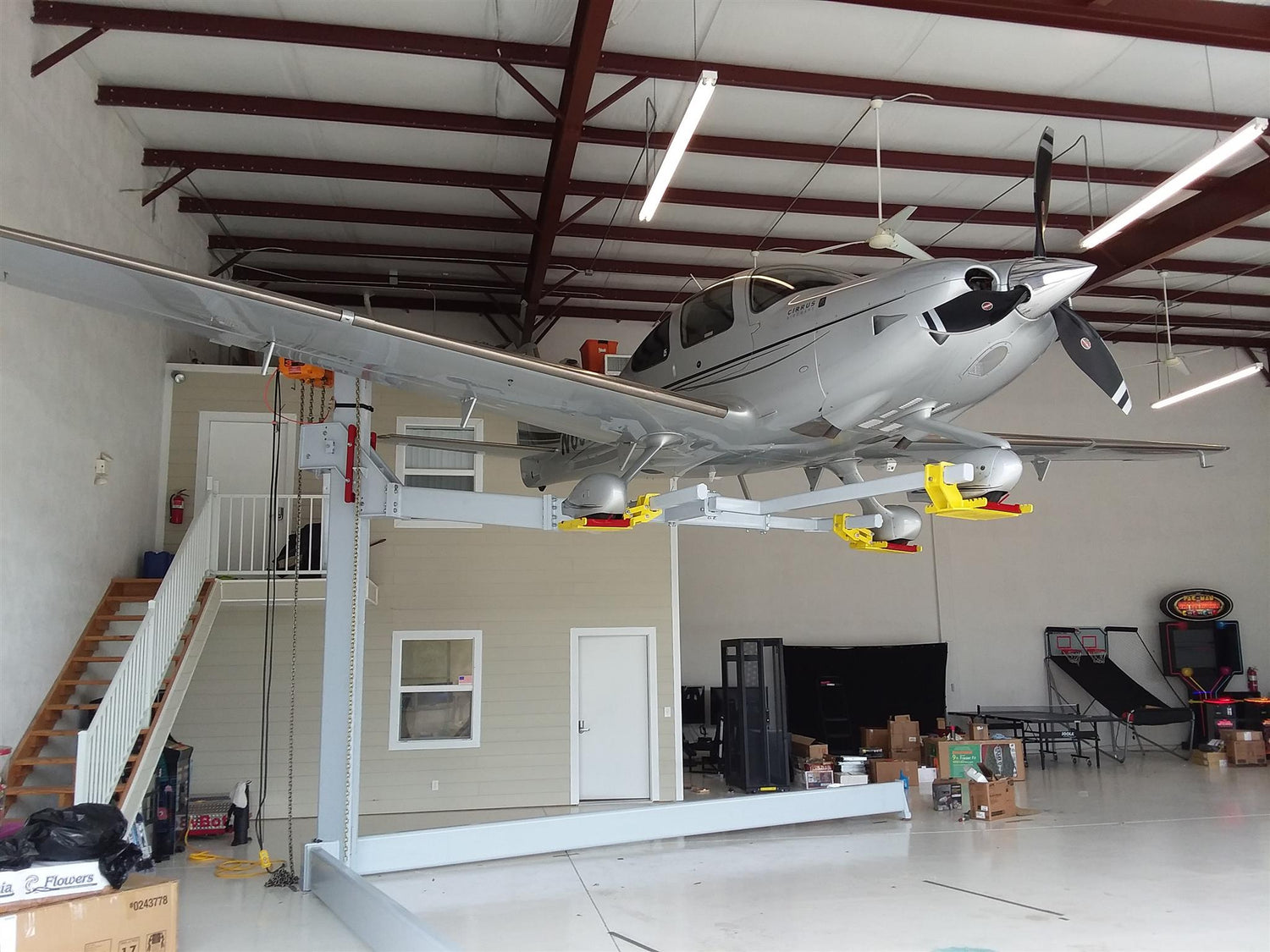
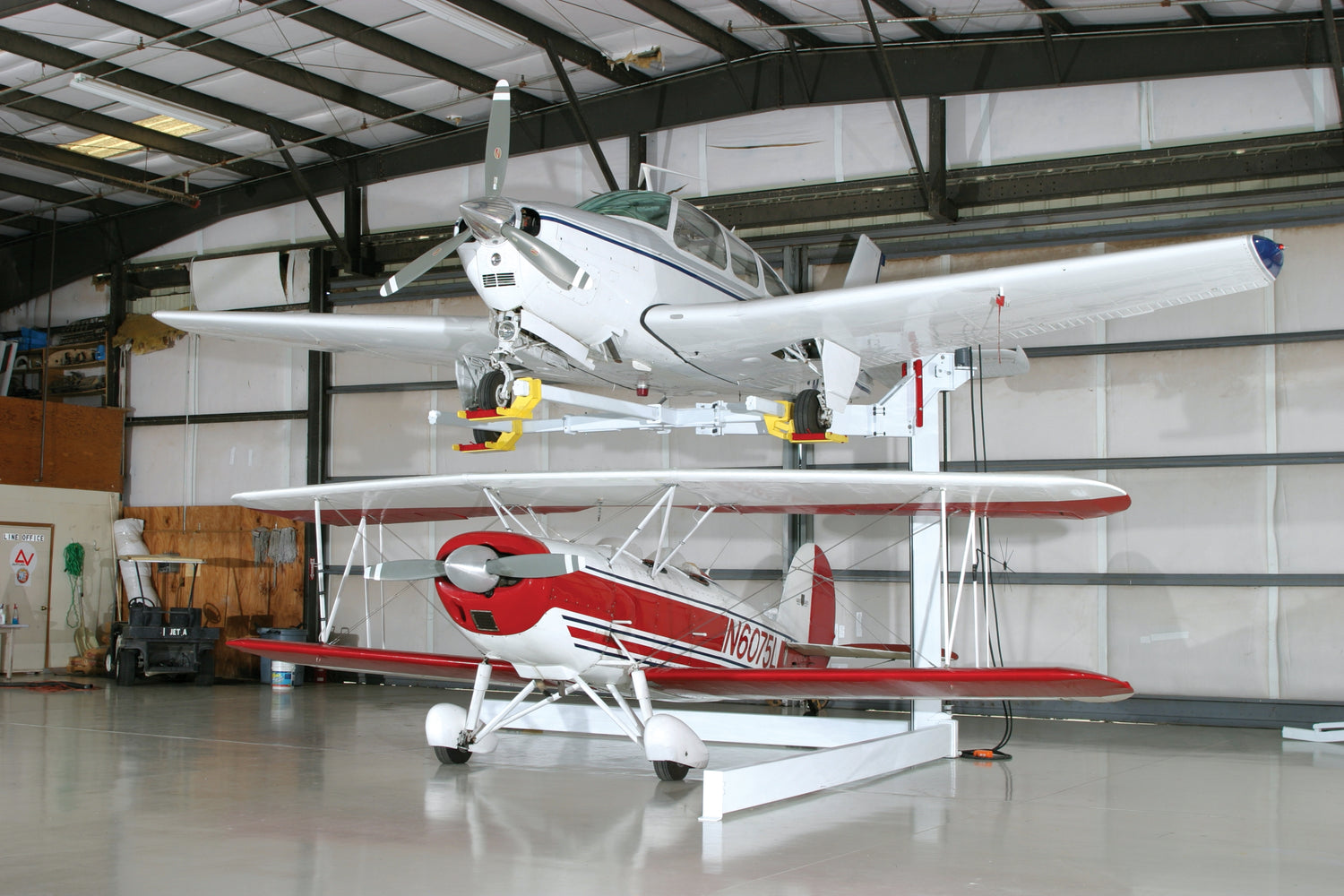
The two 16 foot-long legs that support the main vertical column make up the footprint of your Aero-Lift. These two legs form a perfect right angle at the base of the vertical column. As far as the height of your Aero-Lift is concerned, the top of the vertical column is 14’8”. Since the legs form a right angle at the base of the vertical column, all of the space below your Aero-Lift is open and thus available for whatever use you require. Your Aero-Lift will raise the gear of your aircraft 10 feet above the hangar floor and will provide a full 10 feet of clearance for the vertical stabilizer of a lower aircraft you can nest below. Please refer to the ARM Aerospace webpage entitled Product Specs (insert link) for a dimensional drawing of your Aero-Lift.


Your Aero-Lift is also available with a Floor Mount Option that allows the vertical column to be bolted directly to the floor in your hangar. This approach provides all of the benefits of the Aero-Lift with the footprint on your hangar floor being less than 3 square feet.


Return to top


A.5

Can the Aero-Lift be configured for both tail-dragger and tricycle gear aircraft?


Aero-Lift’’s unique design can accommodate a wide range of airframes and landing gear configurations. You can specify either tail-wheel or tricycle (nose-wheel) or you can order an Aero-Lift outfitted for both styles for maximum flexibility. This dual configuration is particularly popular with FBO and high-density hangaring operators who need to address a wide range of aircraft storage requirements.


Return to top


A.6

Will my plane fit on the Aero-Lift?


Your Aero-Lift was designed to accommodate any aircraft that has a Storage Weight of less than 2,500 lbs and a total gear width of less than 12 feet. With this in mind your Aero-Lift can safely and efficiently lift over 98% of all single engine, piston driven GA aircraft. Beyond that, it is really more a question of how your target aircraft will stack in your hangar. ARM Aerospace offers a Free Hangar Analysis. With this tool you can determine the optimal placement of your Aero-Lift and aircraft. This visualization demonstrates that everything fits in your hangar properly.


Return to top


A.7

How much hangar space do I need for an Aero-Lift?


Your Aero-Lift will physically fit in any aircraft hangar that has 14’8” of ceiling clearance for the vertical column. Beyond that, it is really more a question of determining the best way to configure the target aircraft in your hangar. ARM Aerospace offers a Free Hangar Analysis. With this tool we combine the three views of your specific aircraft, along with a plan view of your hangar, and determine the optimal placement of your Aero-Lift and aircraft. This visualization demonstrates that everything fits in your hangar properly. ARM’s Hangar Analysis produces a drawing depicting the exact placement of all of the components of your Aero-Lift solution, is free of charge and is available to you upon receipt of the accurate measurements and specifications requested.


Return to top


A.8

How high will the Aero-Lift raise my aircraft?


Your Aero-Lift will raise the gear of your aircraft 10 feet above the hangar floor and will provide a full 10 feet of clearance for the vertical stabilizer of a lower aircraft you can nest below.


Return to top


A.9

Does the Aero-Lift need to be "attached" to my hangar?


Your Aero-Lift was designed to be a stand-alone piece of Ground Handling Equipment that would be accepted in any hangar environment. Think of your Aero-Lift as an appliance such as an air compressor or refrigerator. From the design of the electrical system (which plugs into any standard, three prong, 115 VAC, 20 amp circuit) to the legs which distribute the load evenly and safely over your existing hangar floor, this unit is completely free standing with no physical attachment to your hangar. This provides you with the utmost in flexibility and portability of the Aero-Lift and makes the Aero-Lift suitable for installation in even the most restrictive hangaring environments.


Return to top


A.10

What is the Foundation or Floor Mount Option and what is required?


Many Aero-Lift owners who are building a hangar, or are able to retrofit their current hangar, can opt to have the vertical column of the Aero-Lift mounted directly to the floor rather than utilizing the supporting legs. This optional configuration provides the most available clear floor space in your hangar, as the legs are no longer required to support the column.


ARM Aerospace will provide you with blueprints and engineering diagrams for the foundation option. The structure that supports the column is basically a rebar cage, inside a horizontal concrete channel in the floor of the hangar that is roughly 2 feet deep, 3 feet wide and 12 feet long. The rebar cage and channel runs from the base of the column out 12 feet, at an angle, approximately to the CG of the aircraft, i.e. middle of the lift platform.


The Aero-Lift is attached to the floor with a special base plate that uses J-receiver style bolt-ins (basically a large piece of rebar with a receiving nut) that is encased in the concrete and sits flush with the concrete floor of the hangar. There are 10 bolts to mount the base. The base plate is approximately 14" x 18". The column bolts to this base plate using the same bolt holes as the standard legs, 5 bolts in each side. This allows the lift to be reconfigured to accept the standard legs at a later time.


Return to top


A.11

How long will it take me to assemble my Aero-Lift?


The Aero-Lift can be assembled in 2 to 4 man-hours. This does not include receiving, uncrating and reading the Installation Manual. It is preferable to have an installation team of 2 people available for the assembly of your Aero-Lift. Some parts are awkward and heavy and are more easily and safely handled with more than one person.


Return to top


A.12

Is special equipment required to receive the Aero-Lift, and particularly to raise the vertical column?


The preferred method for removing the crate from the truck is a forklift. We recommend that the crate is then set very near where you will set the vertical column. The crate is packed so that the vertical column is tilted straight out of the box into position using a come-a-long, chain hoist, block and tackle or the forklift itself. Once the vertical column is tilted into position the rest of the components (legs, cross beam, motor, etc.) literally "bolt-on" to the vertical column. The legs are approximately 16 feet long and weigh approximately 150 lbs. The vertical column is 14’8” and weighs approximately 750 lbs. and is equipped with a top lifting point.


ARM Aerospace recognizes that the lift is a heavy piece of equipment and that most hangar owners may not have large technical lifting equipment available. We have devoted careful thought and engineering design into the packaging of your Aero-Lift to make the assembly at your hangar as straightforward as possible.


Return to top


A.13

What tools and/or equipment are needed to assemble my Aero-Lift?


Your Aero-Lift is assembled and tested at our manufacturing facility, leaving only a few components to be bolted together to make your Aero-Lift operational. The assembly of these components can be accomplished with simple hand tools. A list of the specific hand tools required is outlined in the Assembly, Operating and Maintenance Manual.


A.14

What options do I have if I don't want to install the Aero-Lift myself?


Usually there is someone with mechanical expertise in the field who can be hired to either help with or complete the installation.


Return to top


A.15

What type of electrical service do I need at my hangar to power the Aero-Lift?


Your Aero-Lift and its drive motor are designed to plug into any standard wall socket with a three-prong plug. The Aero-Lift is no different than any other tool or appliance that you may already have at your hangar, i.e. air compressor, refrigerator, table saw, etc. Technically the motor is 115V single phase reversible that draws 7 amps continuous and 12.1amps at startup and full stall. The hoist motor is a totally enclosed, squirrel cage type, with CSA electrical certification, IP55 environmental protection, Class A motor insulation and is rated at 0.73 horsepower. We recommend a circuit and breaker or fuse rated at 115VAC, 20 amps. If an extension cord must be employed, make sure it is rated at 20 amps, and keep its length less than 40 feet.


Return to top


A.16

Once my Aero-Lift is completely assembled, how difficult is it to adjust its position in my hangar?


Your Aero-Lift weighs approximately 2,700 lbs when fully assembled. So, placement in the correct position during your initial installation is critical. If you need to relocate or adjust the position of the Aero-Lift, a substantial amount of disassembly and reassembly is required. However, ARM Aerospace realizes that there are often situations where the position of your Aero-Lift needs to be adjusted in your hangar. To make the Aero-Lift as flexible as possible, ARM Aerospace offers a Castering Option for your Aero-Lift. The Castering Option lets you raise the fully assembled Aero-Lift easily and quickly onto three casters so one person can roll it around your hangar. The Castering Option is extremely popular as it allows for adjustments in the position of the lift during, and after, the final assembly process is complete.


Return to top


A.17

How is the Aero-Lift shipped to my hangar?


Your Aero-Lift is shipped to your hangar in a wooden container that is 16’ x 42” x 16” and weighs approximately 3,000 lbs. It is typically shipped on a flat bed trailer and is trucked right to your hangar door. Once your Aero-Lift has been manufactured, the shipping time is 3 to 7 working days depending on the area of the country where you are located.


Return to top


A.18

Where can I purchase my Aero-Lift?


Your Aero-Lift can be purchased directly from ARM Aerospace. Simply contact ARM Aerospace and we will make sure that the appropriate member of the ARM Aerospace Team handles your inquiry promptly and professionally.


Return to top


A.19

Was the Aero-Lift designed with earthquake concerns in mind?


Your Aero-Lift was designed to meet the demanding specifications of the California Uniform Building Code (UBC) with regard to earthquake stability and safety. If added protection is required or desired, your Aero-Lift can be fitted with the optional Seismic Isolation System that creates the absolute safest and most robust earthquake readiness configuration.


Return to top


A.20

What safety features are designed into the Aero-Lift?


All of the structural elements of your Aero-Lift are designed and manufactured to precision specifications and close tolerances. The chain is rated to 20,000 lbs. The Aero-Lift has been load tested to 125% of its rated capacity.


The Aero-Lift electric chain hoist is designed for frequent use, features advanced hoist technology, easy serviceability and industry-leading quality. The hoist incorporates a fail-safe pull rotor brake which is electrically activated and requires no adjustment. A built-in slip clutch protects the hoist against over-travel and over-load damage. These two features work in conjunction to provide absolute control and safety. Stop the lift at any position within its travel range and it will not move. If power fails, the lift stops and stays in position. It will not move until power is restored and you operate the control pendant.


Return to top


A.21

What is the warranty of the Aero-Lift?


Your Aero-Lift comes from the factory with a 1-year warranty on all parts, structural as well as mechanical. In addition your Aero-Lift was designed to be extremely functional without being overly complex. Thus, your Aero-Lift will give you decades of service with only minor preventative maintenance.


Return to top


A.22

Will my insurance company have any issues with my aircraft being stored on my Aero-Lift?


The "Not In Motion" portion of most aircraft insurance policies makes no distinction between an aircraft resting on the floor of the hangar or resting on any type of hoist. Because your policy coverage can change and not all policies are written identically, we encourage you to verify your policy coverage for Aero-Lift applications with your insurance underwriter or agent.


Return to top